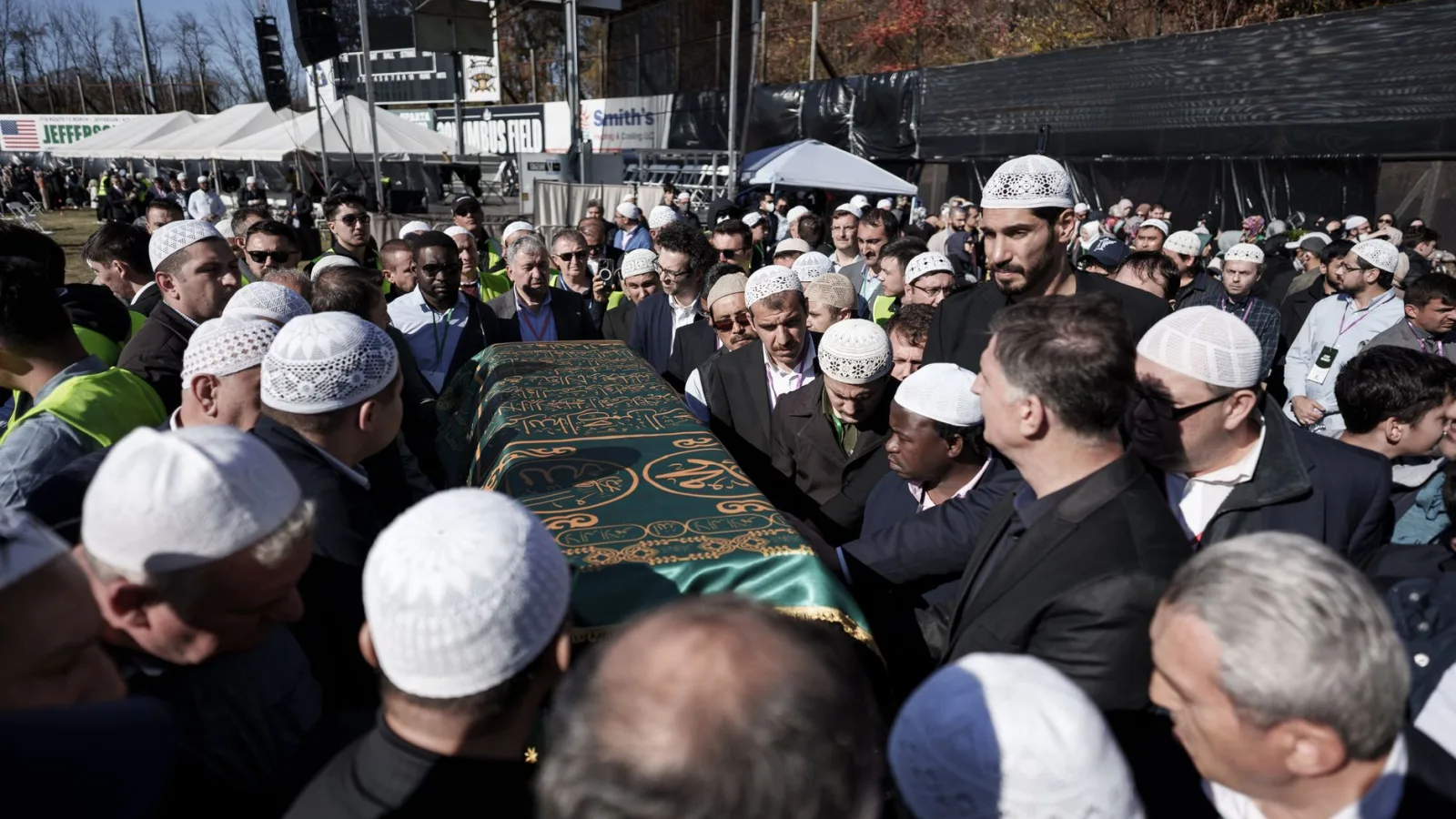
Large crowds gathered in Gaza City for what is understood to be the largest mass funeral held in the territory since the start of the war, as 112 people were buried following a two-week operation to recover their bodies from the rubble of a residential block struck by Israeli forces in late 2023.
The dead, comprising members of the Abu Sharia and Hassayna extended families, included 44 children, 38 women and seven people with disabilities, according to figures reported by those involved in the recovery effort. Footage of the funeral showed the remains arranged in rows, each covered with a Palestinian flag, with some accompanied by photographs of the deceased, before relatives carried them for burial.
The families were killed when a multi-storey residential building in the Sabra neighbourhood of Gaza City was hit on 22 November 2023, six weeks after the Hamas-led attack on southern Israel on 7 October that year, in which 1,200 people were killed and 251 taken hostage, according to Israeli figures. The 22 November strike came during a period of intensive Israeli bombardment of Gaza City.
The BBC has said it approached the Israel Defense Forces for details of what was targeted in the strike but had not received a response at the time of reporting.
The recovery of the bodies was carried out by Gaza's Civil Defence agency, which operates under the Hamas-run interior ministry, with logistical and material support from the International Committee of the Red Cross. Patrick Griffiths, an ICRC spokesperson, said the organisation had supplied protective equipment, body bags and training to help recovery teams work safely and treat the deceased with dignity, and had also funded the rental of excavation machinery, describing it as among the only such equipment available in Gaza for this type of work.
Mahmoud Basal, a spokesperson for the Civil Defence, said the building had contained more than 180 civilians at the time of the strike, with an estimated 90% killed. He said crews had been unable to reach the site immediately after the attack because access required coordination with Israeli forces, typically arranged through an intermediary such as the ICRC, and because of the risks involved in operating in the area at the time.
Relatives of the victims assisted recovery teams during the excavation, directing crews to likely locations of remains beneath the rubble. Family members said they had recovered some bodies in the immediate aftermath of the strike in 2023 but had been unable to retrieve others until the recent operation, which they described as allowing them to give relatives a formal burial after nearly two years.
Dozens more bodies are believed to remain unrecovered at the Sabra site, according to those involved in the operation. Across Gaza more broadly, thousands of people remain unaccounted for, with many believed to be buried under rubble left by air strikes carried out over the course of the war.
According to the Hamas-run health ministry in Gaza, at least 73,377 people have been killed in the territory since the war began. The United Nations has previously stated that it regards the ministry's casualty figures as broadly reliable, despite the absence of independent verification given ongoing access restrictions in Gaza.
The scale of the funeral, and the length of time it took to recover the bodies, reflects broader difficulties documented throughout the conflict in accessing strike sites, coordinating recovery operations and confirming casualty figures. Humanitarian organisations operating in Gaza have repeatedly said that access constraints, damaged infrastructure and a shortage of heavy machinery have slowed efforts to locate and identify the dead, delaying closure for affected families.
Griffiths said confirmation of a relative's death, while painful, was an essential step for families seeking to mourn according to their own customs. Family members present at the Sabra site described the discovery of personal belongings, including children's shoes and school bags, among the debris.
The funeral took place against a backdrop of continued military and political developments in Gaza. Separate reporting has referred to further Israeli strikes resulting in fatalities, as well as statements from Israeli officials regarding conditions for troop withdrawal linked to the disarmament of Hamas. These developments underline that recovery and burial operations, such as the one carried out in Sabra, are continuing in parallel with unresolved aspects of the wider conflict.
The mass funeral in Gaza City stands as one of the most visible instances to date of the delayed identification and burial of victims from strikes early in the war, illustrating both the human toll of the conflict and the logistical challenges that continue to affect efforts to account for the dead.